
Blog · September 8, 2026
Digital marketing for carpenters: what actually books jobs
You do not need everything at once. Here is the order a carpentry shop should build its digital marketing – and how to tell which piece is actually costing you jobs right now.
Rather have it handled?
We help carpentry shops book 5–10 extra high-margin jobs a month.
We build the website, run the local SEO, and automate the follow-up – so you can stay on the tools. Free 15-minute call: we open your Google Business Profile and your site on screen and tell you exactly where the leads are leaking.
Pick a time – free 15-minute audit
Choose a slot below and we will open your website and Google Business Profile on screen, live, and show you exactly where the leads are leaking. No pitch deck, no contract.
Digital marketing for carpenters gets sold as a bundle: website, SEO, ads, social, email, all at once, all this month. That is a good way to spend money without knowing what worked. In practice, a carpentry shop only needs a handful of pieces, built in a specific order, and each one should be paying for itself before the next one starts.
Here is the order, and how to know which step you are actually stuck on.
Step 1: A website that shows the work and makes contact easy
Your website is the only piece you own outright. Everything else – profiles, ads, social platforms – is rented. For a carpenter, it needs to do four jobs:
- Prove the craft. Real project photos, including joinery details and during-construction shots. Stock photos of somebody else’s kitchen actively hurt you.
- Name the scopes you sell. Custom cabinetry, built-ins, trim and finish carpentry, stair work, decks and pergolas, framing – each with its own page.
- Load fast on a phone. Most of your traffic is a homeowner on mobile. Compress the galleries.
- Make contact obvious. Tappable phone number, short form, and a clear statement of the area you serve and the size of work you take.
If your site is more than four or five years old, or you cannot update it yourself, that is usually the constraint. See website design for carpenters and remodelers.
Step 2: Own the map pack in your town
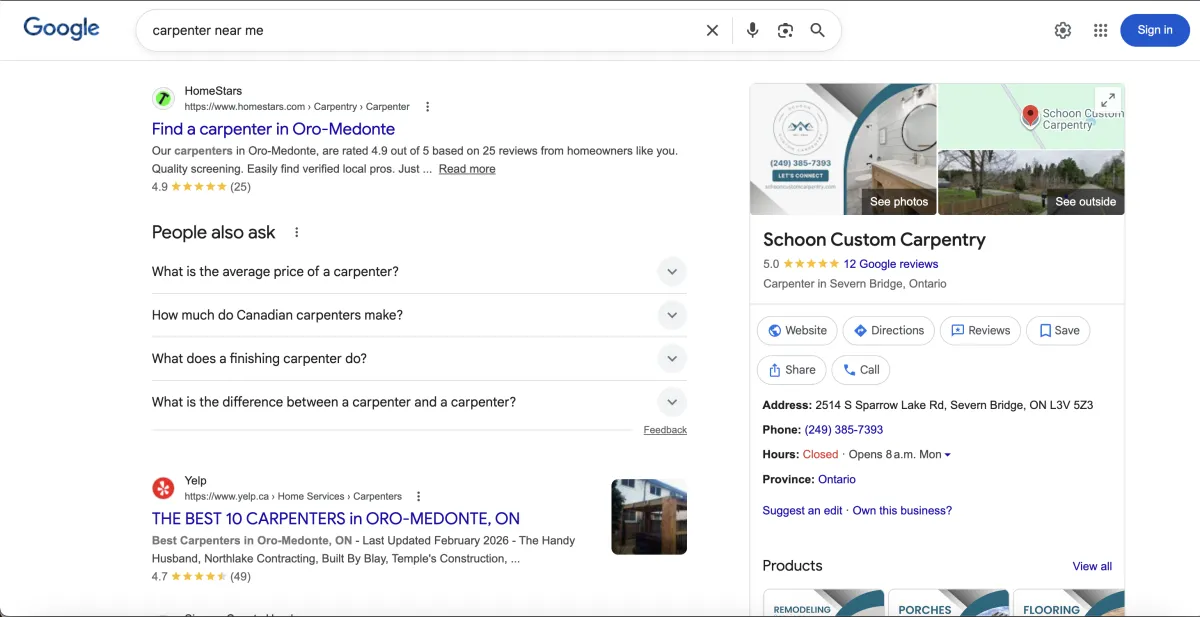
A complete Google Business Profile is the fastest return in the whole stack, and it is free. Right category, correct service area, every service listed with a description, fresh project photos monthly, and reviews coming in steadily.
Most carpenters set the profile up once in 2019 and never touched it again. Reactivating a dormant profile – photos, posts, services, review replies – often moves the phone within weeks, before any website work lands.
Step 3: Local SEO so the pages rank
Once the site and profile are solid, local SEO is what turns them into a steady lead source: scope pages, town pages, cost guides, project stories, consistent business details across directories, and links from local suppliers, builders and associations you already work with.
This is the slow, compounding piece. Expect three to six months before it carries real weight, and expect it to keep producing long after you stop paying for a given article. The full method is in local SEO marketing for remodeling contractors.
Step 4: Paid ads when you need the calendar filled now
Ads do not replace SEO; they cover the gap while SEO matures, or they fill a seasonal hole. For carpentry work, the rules are simple:
- Bid on scope terms, not the trade. “Custom built-in bookcases” converts; “carpenter” burns budget on repair calls.
- Use negative keywords aggressively – jobs, salary, apprentice, courses, repair, cheap, DIY.
- Send clicks to the matching scope page, never to the home page.
- Track calls and forms as conversions, or you are optimizing clicks nobody paid you for.
- Give it enough budget to gather data. A trickle spend produces no signal and no learning.
See what that looks like in practice on our paid ads page, and the real campaign numbers on our results page.

Step 5: Social media as proof, not as a lead machine
Carpentry is one of the few trades with genuinely great content built into the workday. A thirty-second clip of a scribe fit, a dovetail drawer box, or a beam going in outperforms anything an agency can stage.
Just be honest about what it does: social is where homeowners check that you are real after they find you somewhere else, and where past clients remember to refer you. Judge it on that, not on direct inquiries. More on our social media management page.
Step 6: Follow-up automation – the cheapest wins available
This is the step carpenters skip and the one that most reliably prints money. You are on a ladder when the inquiry comes in. By the time you call back that evening, someone else answered first.
- Instant text and email reply to every form fill and missed call.
- Automatic reminders on unanswered estimates at day 3, day 10 and day 30.
- Review request texted automatically when a job is marked complete.
- Every lead in one pipeline with a next action and a date, instead of scattered across texts, voicemail and email.
A shop closing 25% of estimates that fixes response time and follow-up usually lands closer to 35% without a single extra lead. Details on automations and CRM software.
Which step are you stuck on?
| Symptom | The likely bottleneck | Fix first |
|---|---|---|
| Almost no inquiries at all | Visibility | Google Business Profile and local SEO |
| Traffic but no calls | The website or the offer | Site rebuild, scope pages, proof |
| Calls, but wrong-size jobs | Positioning | Scope pages, minimum project size, budget field |
| Estimates that go quiet | Follow-up | Automation and a real pipeline |
| Busy summer, dead winter | No demand smoothing | Paid ads plus email to past clients |
Diagnose before you buy. Nearly every carpenter who tells us marketing does not work turns out to have one broken link in this chain, not five.
Not sure which row is you?
Book a 15-minute call. We will pull up your Google Business Profile and your website live on screen and tell you which step is breaking your lead flow – free, whether or not you hire us.
A budget that makes sense for a small shop
A useful rule for residential trades is 5% to 8% of revenue on marketing while you are growing, weighted toward the compounding assets first. For a shop doing $600,000, that is roughly $2,500 to $4,000 a month across website, SEO, some ads, and the software that keeps follow-up running – and it should be judged against cost per booked job, not cost per lead.
One signed cabinetry package or a single kitchen remodel usually covers a quarter of that. That is the math worth checking before deciding marketing is expensive.
Start here
- Search your top three scopes plus your town on your phone and write down where you appear.
- Open your Google Business Profile and fix category, services, service area and photos this week.
- Give your two highest-margin scopes their own website pages with real project photos.
- Turn on instant reply and estimate reminders.
- Only then decide whether to add paid ads.
Do that in order and digital marketing stops being an expense you hope works and becomes a system you can read – job by job, month by month.
Keep reading
Frequently asked questions
What digital marketing works best for carpenters?
A fast website with real project photos and one page per scope, an active Google Business Profile, local SEO for scope-plus-city searches, and automated follow-up. Paid ads and social media are additions once those four are working.
How much should a carpenter spend on digital marketing?
A common range for a growing residential trades business is 5% to 8% of revenue, weighted first toward the website, local SEO and follow-up systems. Judge the spend on cost per booked job rather than cost per lead.
How long before digital marketing produces jobs?
Google Business Profile improvements and follow-up automation can move the phone within weeks. Local SEO usually takes three to six months to carry real weight and keeps compounding after that.
Do carpenters need social media to get work?
Social media is mainly proof and referral reinforcement rather than a direct lead source. Homeowners check it after finding you elsewhere, so a steady feed of real jobsite work is worth keeping, but it should not be the first investment.
Want this handled for you?
Book a free discovery call and we will walk your website, Google Business Profile, and follow-up system, then show you exactly where the leads are leaking.